
Table of Contents
If you’ve ever wondered whether you need a coach or a therapist, you’re not alone. In today’s wellness landscape, the lines between personal growth, mental health, and self-development can feel blurry—and that confusion is completely understandable.
Coaching and therapy share meaningful overlap: both are relational, reflective, and rooted in the belief that people can change. Neither is inherently “better” than the other. They simply serve different purposes.
For clarity, when this article refers to coaching, it is specifically speaking to the Reverie approach to coaching - depth-oriented coaching: a non-clinical, future-focused practice that integrates insight, meaning, and pattern awareness with clear goals, ethical boundaries, and intentional action.
This article isn’t here to tell you what you should choose. Instead, it’s designed as a clarity tool—one that de-stigmatizes both options, honors their overlap, and helps you understand which form of support may best meet you where you are right now.
This distinction matters deeply to me on a personal and professional level. I recently completed a depth-oriented coaching certification through the Inner Compass Academy, led by licensed therapist, Vanessa Bennett. I was drawn to this training because I value depth and soul-centered work—principles that are foundational to my therapeutic training and clinical practice, and that I also believe can be meaningfully held within ethical coaching spaces.
The way I understand coaching is as a time-limited, outcome-focused container. In coaching sessions, I take a more directive stance, walking you through specific protocols that we co-create together, drawing from the Reverie Practice coaching curriculum I’ve developed. Therapy, by contrast, often allows for a more spacious and nonlinear process—one that holds room for past experiences, wound healing, and the long arc of trauma recovery.
My approach to coaching is deeply informed by my extensive background in trauma support, while remaining clear about scope and boundaries. It is designed for those who have already done significant healing work and are ready to explore what comes next: integration, meaning, direction, and aligned action.
Why Coaching and Therapy Are Often Confused
Both coaching and therapy increasingly draw from trauma-informed perspectives—emphasizing safety, consent, nervous system awareness, and respect for personal pacing. As these principles become more widely adopted across the wellness field, the overlap can make distinctions feel even less clear.
The confusion between coaching and therapy didn’t come from nowhere.
Both coaches and therapists:
Ask thoughtful, sometimes challenging questions
Help clients notice patterns, beliefs, and behaviors
Support insight, growth, and meaningful change
Work within a confidential, one‑to‑one relationship
Add to that a modern wellness culture that blends psychology, mindfulness, neuroscience, and personal development—and it’s easy to see why the distinction can feel fuzzy.
This overlap isn’t a problem. It’s a reflection of how complex and layered human growth actually is. The key difference lies not in depth or care, but in scope, training, ethics, and intention.
What’s the Difference Between a Therapist and a Coach?
At a high level, the distinction comes down to what each role is designed—and legally permitted—to do. Below, we’ll explore this more deeply.
What Does a Therapist Do?
A therapist is a licensed mental health professional trained to assess, diagnose, and treat psychological distress and mental health conditions.
Key elements of therapy include:
Credentials and licensure (e.g., LCSW, LMFT, LPC, Psychologist)
Formal education and supervised clinical training
Legal and ethical regulation by state boards
Ability to diagnose and treat mental health disorders
Therapy is designed to support healing from:
Trauma and PTSD
Anxiety and depression
Attachment wounds and relational patterns
Grief, loss, and chronic stress
Other clinically significant mental health concerns
Therapists may work with the past, present, and future, often helping clients integrate earlier experiences so they can live with more stability, resilience, and psychological flexibility.
What Does a Depth-Oriented Coach Do?
A depth-oriented coach is a non-clinical professional who supports clients in clarifying goals and direction while also engaging the inner patterns, values, and meaning that shape how those goals are pursued.
At Reverie, depth-oriented coaching is grounded in trauma-informed principles—including choice, collaboration, nervous system awareness, and respect for individual pacing—without crossing into trauma processing or clinical treatment.
Depth-oriented coaching is not about surface-level motivation or quick fixes. It honors complexity while remaining grounded in forward movement.
Core aspects of depth-oriented coaching include:
Future orientation with psychological insight and nervous system awareness
Values- and meaning-based goal setting rooted in safety and consent
Exploration of patterns, beliefs, and internal narratives without reactivation
Reflective dialogue paired with practical, embodied integration
Clear non-clinical boundaries and ethical referral practices
Coaching does not diagnose or treat mental illness. This boundary doesn’t limit the work—it defines it. Depth-oriented, trauma-informed coaching works with psychologically stable clients who are ready to integrate insight into action, rather than process active trauma or clinical symptoms.
High-quality depth-oriented coaching can be especially meaningful for those who are:
Seeking clarity after significant healing or therapy work
Navigating identity shifts or life transitions
Wanting to align inner values with outer choices
Ready to move from insight into embodied, intentional action
Coaching vs Therapy: Understanding the Difference
A trauma-informed lens makes this distinction even more important.
Both therapy and coaching can be practiced with trauma awareness, but they carry different responsibilities. Trauma-informed practice means knowing not only how to go deep, but when not to—and how to recognize signs that deeper clinical support may be needed.
There are gray areas—and it’s important to be honest about them.
Some therapeutic conversations feel future‑focused. Some coaching conversations touch on emotions, patterns, or old stories. What matters is not avoiding overlap, but honoring ethical boundaries.
This is where training, scope, and referral protocols become essential.
Trauma‑informed coaches understand when depth is appropriate—and when it’s time to slow down, re‑orient, or refer out.
Education and Training
Therapists and coaches take very different educational paths:
Therapists complete graduate‑level clinical degrees, hundreds to thousands of supervised hours, licensing exams, and ongoing continuing education.
Coaches may train through certification programs, mentorship, and specialized modalities. While unregulated, many follow established ethical frameworks and continuing education standards.
Neither path is inherently superior—they are simply designed for different scopes of care. One aspect of education that is often overlooked in both therapy and coaching is the learning that comes through lived experience. While lived experience does not replace formal training, it has deeply shaped how I show up in this work. It informs my capacity for attunement, humility, and embodied understanding. When held with care and clear boundaries, lived experience becomes a quiet source of insight—not something imposed on the work, but something that supports presence, discernment, and respect for each client’s unique process.
Different Approaches to Therapy and Coaching
Therapy may include modalities such as:
Cognitive Behavioral Therapy (CBT)
Psychodynamic or attachment‑based therapy
EMDR or other trauma‑processing approaches
Coaching approaches may include:
Values‑based or somatic coaching
Narrative and meaning‑making practices
Depth oriented coaching
Integrative, trauma‑informed coaching styles
While tools may overlap, the intention and responsibility behind their use differs.
Coaching and Therapy Benefits
Therapy benefits may include:
Reduced symptoms of anxiety or depression
Greater emotional regulation
Trauma integration and healing
Improved relational patterns
Coaching benefits may include:
Increased clarity and confidence without overwhelm
Support during change or transition with attention to nervous system capacity
Stronger follow-through and accountability that respects pacing
Integration of insight into action in a regulated, grounded way
Alignment between values, goals, and lived experience
Do Therapy and Coaching Address Different Problems?
Yes—and the comparison below helps illustrate how.
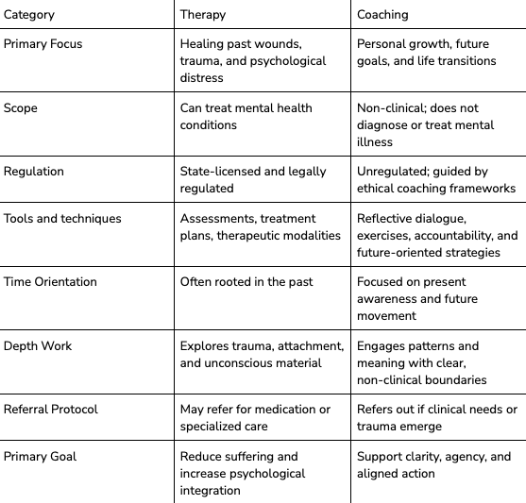
How Do I Know If I Need a Life Coach or a Therapist?
The table above offers a starting point. Below are more specific signals.
When Coaching May Be the Right Choice
Coaching may be supportive if you:
Feel generally stable but stuck or uncertain
Are navigating a life or career transition
Want support clarifying values or direction
Are seeking accountability and momentum
Want growth‑oriented, future‑focused support
When Therapy Is the Better Fit
Therapy is likely the better option if you’re experiencing:
Depression, anxiety, or panic symptoms
Trauma or PTSD
Thoughts of self‑harm or harm to others
Significant emotional dysregulation
Patterns that feel overwhelming or unsafe
Naming these boundaries builds trust—and protects your well‑being.
Can Coaching and Therapy Work Together?
Yes. Many people benefit from both, either sequentially or concurrently.
A therapist might help stabilize and heal underlying wounds, while a coach supports integration, growth, and forward movement. When done ethically, this combination can be powerful.
Coaching vs Therapy: Everything You Need to Know
Is Coaching Regulated?
No. Coaching is not state‑licensed, which makes ethical standards and referrals especially important.
Does Insurance Cover Coaching?
Typically no. Therapy is sometimes covered; coaching is usually self‑pay.
Can I Do Coaching Online?
Yes. Coaching is commonly offered virtually. We are able to expand our reach and accessibility by offering coaching outside of Colorado through virtual services.
Is Life Coaching the Same as Therapy?
No. While there is overlap, they serve different purposes and scopes.
Is Mental Health Coaching Therapy?
No. Even when trauma‑informed, coaching remains non‑clinical.
Can a Coach Help With Trauma?
A coach can support awareness and stabilization—but should refer out for trauma processing.
Who Should See a Therapist Instead of a Coach?
Anyone experiencing active mental health symptoms, safety concerns, or unresolved trauma should begin with therapy.
Coaching and Therapy at Reverie
Reverie’s work is rooted in a trauma-informed foundation—whether in therapy or coaching.
We prioritize safety, consent, pacing, and nervous system awareness, while maintaining clear ethical boundaries between clinical treatment and non-clinical support. Our depth-oriented coaching is intentionally designed for clients who have done foundational healing work and are ready to explore integration, meaning, and forward movement without re-entering trauma processing.
We believe clarity, boundaries, and choice are central to ethical trauma-informed care.
At Reverie, we hold these distinctions with care.
Whether you’re seeking healing, growth, or a thoughtful blend of both, our intention is the same: to support you in choosing what truly serves you.
If you’re unsure where to begin, we’re here to help you explore your options—without pressure, judgment, or one‑size‑fits‑all answers.
Interested in Group Work, but Want to Know More?
Subscribe to receive our FREE guide to group work, and learn more about what to expect.